
Helping busy women break the cycle of starting over with their health goals and stay consistent long term. One step, one meal, one habit at a time.
Simple, real-life programmes that help you move more, eat better and stay consistent without starting over and over again.
I’m averaging 10k steps a day for almost a year now,
so thanks again for giving me my boost!
JAYE
My name is Jacqueline & I'm a health & habit coach
I know what it feels like to keep starting over with your heath and fitness goals.
That’s why I created boostbyjax, a space where women can find structure, support and a simple way to stay consistent daily with being active and eating better.
As a certified coach, I’ve helped hundreds of women take small steps that lead to lasting change.
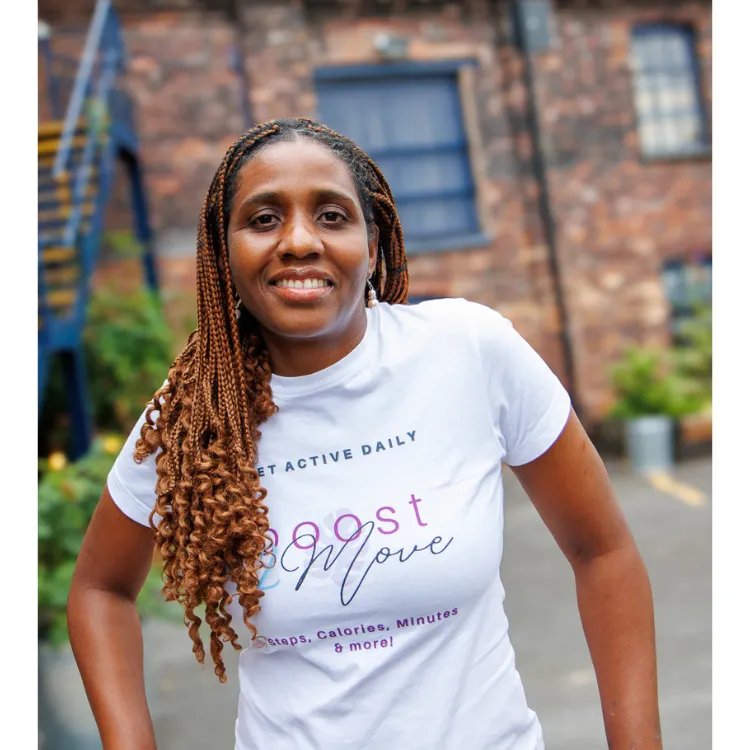
one step, one meal, one new habit
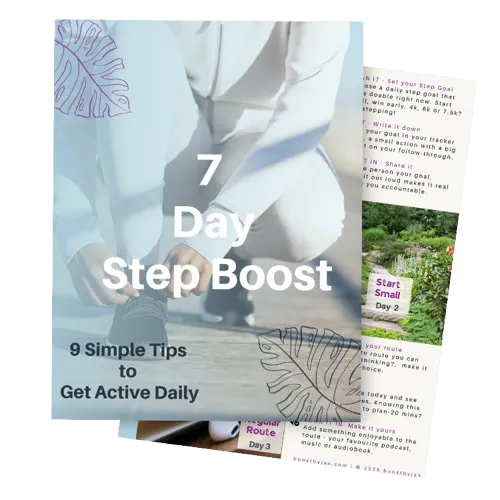
Grab Your
FREE Guide
7 DAY STEPS BOOST
9 Simple tips woven into a 7 day plan to get you active daily with steps.
Ready to build consistency?

Get Your Weekly Boost
The space where I share real, honest and encouraging notes each week to help you reset, reflect and take one step forward. Whether it’s a gentle nudge, a personal story or a practical tip, this is your space for growth on your terms. The weekly boost is a time for personal growth, movement through steps and eating good food that nourishes.
Real-life progress - No pressure -Just possibility.
Ready to build healthy habits that stick?
Let’s start with your steps and meals.
Real change doesn’t start with extremes but starts with simple, consistent actions that fit your life.
My steps and eating programmes are designed to help you build health habits that last, with structure, accountability and a touch off fun along the way.


Follow Me
On Instagram
Get tips, inspiration and behind-the-scenes insights to help you stay motivated and find the right approach to build consistent steps and good eating habits.
Ready to build the life of your dreams?

Let's chat
Ready to work with a coach to uplevel your life and business?
Listen to the
Podcast
view my
services
read the
BLOG
Let's chat
Ready to work with a coach to uplevel your life and business?


Let's learn
Learn at your own pace and make quantum leaps.
Are you ready for more?
Student Love Notes
We've helped so many incredible students to find success as Virtual Assistants...

The VA Business Blueprint helped me to go from feeling completely stuck to starting my business and getting my first client!
Ellen, business name

I enrolled in the VA Services Academy feeling completely lost - within 2 weeks I knew exactly what to offer & what to charge.
Ellen, business name

Beginner to Booked Out was a game-changer for me. Anna and her team are incredible and I'm booked out for the next 3 months!
Ellen, business name
New on the blog...

When You Fast:A journey without a destination
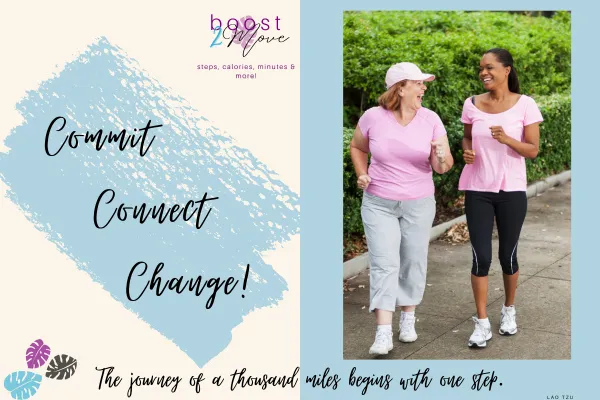
From 10,000 Steps Daily to 5 million a year!

Fed up with your eating habits?
New on the blog...

How to Stay Consistent With Exercise After 40
Struggling to stay consistent with exercise after 40? The problem usually isn't motivation, it's trying to do it alone. Research shows habits take an average of 66 days to stick and structured accountability roughly doubles the odds you'll still be moving in a month's time.
Who Are You Becoming This Month?
July marks the start of the second half of the year and with it, another chance to choose the direction you're heading. It's easy to tell yourself what you're going to do. The harder question is who you're becoming.
Are you becoming someone who waits for motivation to show up?Or someone who backs herself by taking action and keeping the promises she makes to herself, even when life doesn't go to plan?
That question sits at the heart of how to stay consistent with exercise after 40 and most advice focuses on the workout.
The real work happens in the gap between deciding and doing, day after day, especially once hormones, schedules and decades of stop-start dieting have made "just be more disciplined" feel like a joke.
Why Does Motivation Always Run Out?
Motivation is a feeling, not a strategy and feelings are unreliable by design. It spikes when something is new or urgent, then fades within days as the novelty wears off, which is exactly when most exercise plans quietly die with it.
This is not a personal failing. It is how motivation works for every human being, at every age. The women I coach through Break the Cycle almost always arrive believing they simply lack willpower, when what they actually lack is a structure that doesn't depend on how they feel that morning.
What replaces motivation is a system: a set promise, a way to track it and someone checking in. Trackers like an Apple Watch or Fitbit can show you the pattern, but a digital tracker alone doesn't build the habit. It just shows you whether the structure around it is working.
How Long Does It Actually Take to Build an Exercise Habit?
On average, it takes 66 days for a new daily behaviour to feel automatic, not the 21 days most people expect. That figure comes from a landmark 2010 study by Phillippa Lally and colleagues at the Cancer Research UK Health Behaviour Research Centre, based at University College London (UCL), published in the European Journal of Social Psychology.
Lally's team tracked 96 people choosing one new daily habit over 12 weeks. The automaticity point ranged from 18 days to 254 days depending on the person and the behaviour, which is a reminder that comparing your progress to someone else's timeline is pointless. I personally found mine to be around the 160 day mark.
The single most useful finding, though, is this: missing one day did not meaningfully disrupt the habit-forming curve.
One skipped walk isn't the end of your consistency. It's only a problem if one missed day quietly becomes two, then a lost week, then starting over again in September.
https://boostbyjax.com/post/stay-consistent-when-life-gets-busy - "The Boost Minimum approach to daily movement"
What's the Difference Between Trying Alone and Having Structure?
Structure and accountability roughly double how long people stick with an exercise routine compared with going it alone.
A 2016 systematic review in the journal Preventive Medicine found community-based group exercise programmes averaged a 69% adherence rate over six months or longer, well above typical solo dropout rates.
Last week, one of the women in my Break the Cycle group shared her Apple Watch averages with me. Twelve days earlier she was averaging 2,263 steps a day. By the time she messaged me, she was averaging over 14,000.
The number wasn't what made me smile. It was the decision behind it. Instead of trying to change alone again, she chose structure, support, and accountability. She still walked every single step herself, but she stopped walking that road on her own.
That's the whole premise behind break the cycle, my 10-day movement, healthy habits and accountability programme: not a stricter plan, but company for the journey. https://boostbyjax.com/post/5millionstepsjourney - one reader's journey from 10,000 steps a day to 5 million a year.
https://boostbyjax.com/breakthecycle - join the 24 July Break the Cycle group to start your journey.
How Do You Choose a Promise You Can Actually Keep?
Pick one promise you genuinely believe you can keep, not the biggest target or the "perfect" week target. A promise sized to your real life, on a real Tuesday, not one you cleared your diary for, one that survives contact with a bad night's sleep or a packed diary.
Ambition feels productive, but it's often what sets people up to fail by week two. A ten-minute walk you'll do daily actually beats an hour-long gym session you'll skip and do every few months.
Keeping the promise is what changes you, not the size of it.
Every kept promise, however small is evidence to yourself that you're someone who follows through, which is the identity shift that makes the next promise easier to keep. https://boostbyjax.com/post/stay-active-when-life-gets-busy -"building fitness without relying on long workouts"
What Happens When You Miss a Day?
One missed day is data, not a verdict. As Lally's research shows, a single skipped session doesn't erase the progress your habit has already built, so treat it as information about that day, not proof about you.
The danger isn't the missed Thursday. It's the story we tell ourselves afterwards: "I've ruined it, I may as well stop."
That story, repeated often enough, is what actually breaks consistency, not the missed walk itself.
Nothing becomes two days. One missed session followed immediately by the next scheduled one keeps the habit intact. It's the second missed day, the "I'll restart Monday" delay, that quietly restarts the whole cycle. https://boostbyjax.com/post/stop-the-drift-before-weight-creeps-back-on — "how small streaks stop weight creeping back on"
Willpower Alone vs. Structure and Accountability
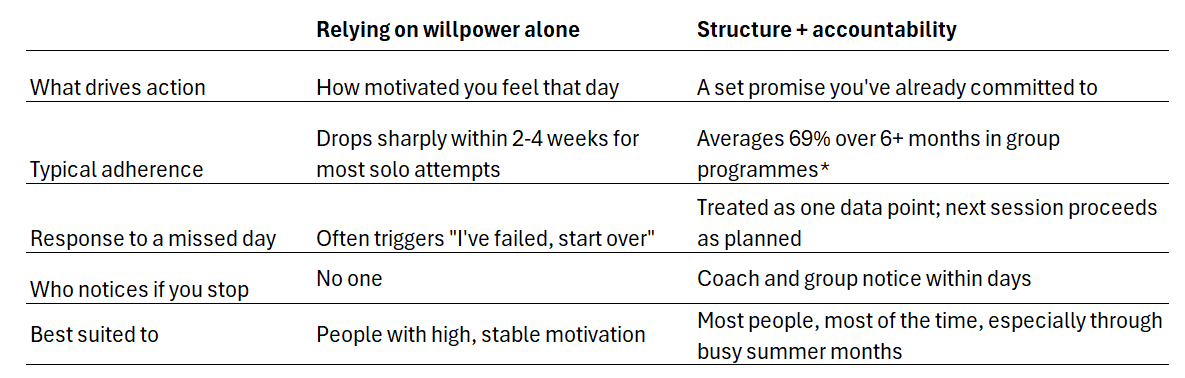
*https://www.sciencedirect.com/science/article/pii/S0091743516300147 - ScienceDirect systematic review — "community-based group exercise adherence review"
Why July Is the Month to Build This
Summer holidays are here, and they interrupt everyone's routine, which is exactly why now is the time to start rather than wait for a calmer season. A habit that's only ever been tried during a quiet week hasn't really been tested. Waiting for the "perfect" moment just delays it until autumn, when the pattern of starting over repeats itself again.
If July becomes another month of starting over, the pattern doesn't break itself in September either. The women who build their routine through the disruption of summer, rather than waiting for it to pass, tend to come out the other side still moving.
The next Break the Cycle group starts 24 July, giving you the first 66-day habit-forming window during a disruptive season rather than after it. Building automaticity while your routine is genuinely being pulled in different directions is what makes it stick, whatever the rest of the year throws at you.
https://boostbyjax.com/breakthecycle - join the 24 July Break the Cycle programme
FAQs: Staying Consistent With Exercise After 40
Q: Why is it so hard to stay consistent with exercise after 40?
A: It's rarely about willpower. Hormonal changes, busier schedules, and years of all-or-nothing dieting all erode motivation faster, so a system that doesn't depend on feeling motivated works better than trying harder.
Q: How many days does it really take to build an exercise habit? A: Lally et al. (2010, UCL) found an average of 66 days, with a range of 18 to 254 depending on the person and behaviour. Missing a single day did not disrupt the habit-forming process.
Q: Does an accountability group actually help with exercise consistency?
A: Yes. A 2016 systematic review found community-based group exercise programmes averaged 69% adherence over six months or more, well above typical solo dropout rates.
Q: What should I do if I miss a day of my routine?
A: Continue with your next scheduled session as planned.
One missed day is a data point, not a failure. It's a second consecutive missed day that tends to restart the whole cycle.
Q: What's the easiest way to start building consistency this month?
A: Choose one promise you genuinely believe you can keep, not the biggest or "perfect" one, and add structure and accountability around it rather than relying on daily motivation.
The Real Question This Month
Who are you becoming this month?
Not what will you do, but who are you becoming by doing it, one kept promise at a time.
Consistency doesn't come from bigger targets or perfect weeks. It comes from one believable promise, kept, with someone alongside you who notices if you stop.
If you're ready to stop starting over, Break the Cycle is the ten-day starting point that leads into everything else.
https://boostbyjax.com/breakthecycle - begin with Break the Cycle